
Khalid Turk
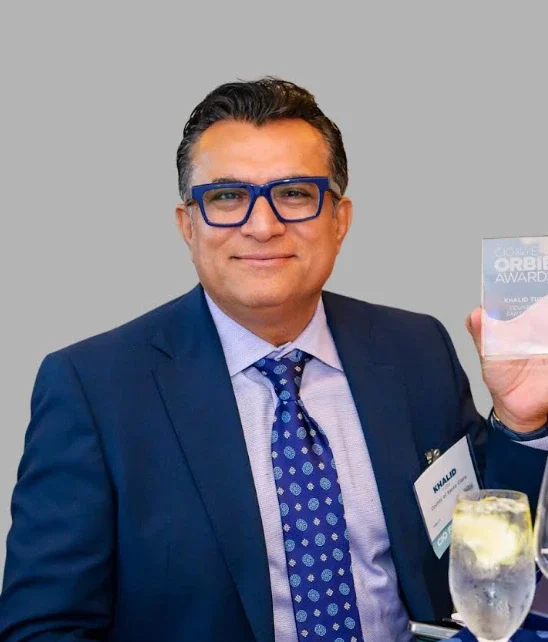
Chief Healthcare Info Tech Officer at County of Santa Clara
Khalid Turk: Building Credibility, Clarity, and Execution in Modern Healthcare Leadership
In an era where technology leaders are often defined by buzzwords rather than outcomes, Khalid Turk has built a reputation rooted in execution, trust, and measurable impact. As Chief Healthcare Information Technology Officer for the County of Santa Clara, he operates at the center of one of the most complex and demanding environments in the public sector. His work influences clinical care, operational resilience, cybersecurity readiness, and digital transformation at a scale where decisions are not theoretical. They affect lives.
Turk’s career has never followed a straight line, yet it has remained consistently anchored in one domain: leading technology and transformation in high-stakes systems. Over time, that foundation has expanded beyond enterprise leadership into authorship, national speaking, and advisory work with founders and executives navigating growth. The result is a professional identity that is broad but not diluted, ambitious but grounded.
“My career has been intentionally non-linear,” Turk has said, “but consistently grounded in operational leadership in complex environments.” That grounding has shaped not only how he leads, but also how he advises, teaches, and communicates.
Today, Turk is recognized not only as a healthcare CIO but also as an author, speaker, founder of ExecPresenceOnline, and creator of Pitch With Khalid Turk. Each role connects back to a single throughline: helping leaders move from ideas to outcomes with clarity, credibility, and discipline.
Leadership Grounded in Real-World Consequence
Healthcare is often described as complex, but Turk prefers a more direct framing. It is unforgiving. There is limited tolerance for delay, misalignment, or abstract thinking. Regulatory pressure, operational constraints, and patient safety create an environment where leadership must be practical, decisive, and accountable.
In his role with the County of Santa Clara, Turk is responsible for technology strategy, enterprise systems, cybersecurity posture, and large-scale digital initiatives that support both clinical and administrative operations. The scope requires close collaboration with clinicians, finance leaders, operational teams, and governance bodies. Success depends on trust as much as technical skill.
“Outcomes matter. Trust matters,” Turk has noted. “Decisions have real human consequences.”
That reality shaped his leadership philosophy early. Rather than positioning technology as an isolated function, he evolved into an enterprise leader who focuses on alignment across disciplines. Strategy, in his view, only matters if it can be translated into execution within real constraints.
Over time, those experiences sharpened his ability to operate in ambiguity and to make progress even when conditions are imperfect. That same muscle now informs how he works beyond healthcare, particularly with early-stage companies that face uncertainty of a different kind.
A Defining Challenge and a Shift in Perspective
One of the most formative moments in Turk’s career came during a mission-critical initiative marked by extreme time pressure, regulatory scrutiny, and organizational complexity. Traditional governance models, designed for stability rather than urgency, began to collapse under the weight of real-world demands.
Rather than doubling down on control, Turk and his team made a deliberate shift. They focused on minimum viable outcomes, faster feedback loops, and empowered decision-making closer to the work itself. The approach required trust, clarity, and discipline, but it delivered results.
That experience permanently altered how Turk views leadership.
“Leadership is not about controlling variables,” he has said. “It’s about designing systems that can adapt.”
The lesson transcended healthcare. While the context of startups differs from public-sector health systems, Turk sees a shared truth. Early-stage companies also fail when they rely too heavily on perfect plans and rigid structures. Progress comes from learning velocity, execution discipline, and alignment around a clear story.
This insight became the connective tissue between Turk’s CIO role, his writing, his speaking engagements, and his advisory work. The environments may change, but the leadership principles remain consistent.
What Sets Effective Leaders Apart Today
According to Turk, modern leadership is no longer defined by title or tenure alone. In today’s environment, extraordinary leaders share three defining traits.
The first is contextual intelligence. Effective leaders understand what matters now, not what mattered in a previous role, a different industry, or a past market cycle. They adjust their approach without abandoning core principles.
The second is execution literacy. These leaders understand how ideas become operational reality. They grasp incentives, constraints, trade-offs, and human dynamics. They know where plans tend to break and how to adapt before failure becomes visible.
The third is narrative discipline. Leaders must be able to articulate a clear and consistent story that aligns teams, boards, investors, and partners. In healthcare, that narrative builds trust and confidence. In startups, it creates momentum and belief.
“Leaders who can align strategy, execution, and communication consistently outperform those who treat these as separate skills,” Turk has observed.
This belief sits at the center of his work as both an operator and an advisor.
Building Culture Through Behavior, Not Slogans
Culture, in Turk’s view, is not aspirational language displayed on walls or websites. It is behavioral. It is reflected in how decisions are made, how accountability is enforced, and how risk is understood.
Within healthcare systems, Turk focuses on building cultures that value accountability, psychological safety, and cross-functional collaboration. Teams must feel safe to surface issues early, but also clear about expectations and outcomes.
In startup and advisory contexts, the same principles apply, with an added emphasis on speed and ownership. Smaller teams magnify both clarity and confusion. Leaders who are explicit about decision rights, success metrics, and acceptable risk create momentum. Those who rely on ambiguity slow progress.
“Ambiguity slows organizations,” Turk has said. “Clarity accelerates them.”
Through ExecPresenceOnline, Turk works with leaders to align internal culture with external presence. He has seen firsthand how disconnects between how leaders operate internally and how they show up publicly eventually become growth constraints. Authenticity, in this sense, is operational consistency.
Innovation With Discipline and Proximity
Innovation in healthcare carries a unique burden. It must balance advancement with safety, compliance, and public trust. Turk approaches innovation not as disruption for its own sake, but as disciplined improvement rooted in real needs.
He emphasizes proximity as a core innovation principle. Staying close to clinicians, frontline staff, and patients ensures that technology investments address real problems rather than perceived ones. Data informs decisions, but direct engagement validates them.
In startup environments, proximity takes a different form. It means staying close to customers, markets, and early signals. Turk often observes organizations struggle when their story outpaces their readiness. Promises become larger than products, and momentum becomes fragile.
Through his advisory work, he helps leaders align product maturity, go-to-market strategy, and executive presence. The goal is sustainable growth rather than reactive scaling.
Mentorship, Learning, and Signal Over Noise
Mentorship has played a critical role in Turk’s own development. Guidance from peers and senior leaders who had navigated complexity before him provided perspective during pivotal moments.
As his career progressed, Turk became more intentional about giving back. Rather than offering broad, generic mentorship, he focused on high-signal engagement. This approach shaped Pitch With Khalid Turk, a platform designed to expose founders to executive-level questioning, practical go-to-market feedback, and pattern recognition drawn from enterprise-scale environments.
The emphasis is not on motivation, but on readiness.
Turk is also a strong advocate for continuous learning. Markets evolve, technologies shift, and leadership expectations change. Leaders who stop learning, regardless of title, eventually lose relevance.
“Continuous learning is not optional for modern leaders,” he has said.
Extending Identity Without Dilution
One of the most distinctive aspects of Turk’s career is how he has expanded his professional identity without fragmenting it. His work as a CIO, author, speaker, and advisor is not a pivot away from healthcare leadership, but an extension of it.
He remains firmly anchored in his role as a healthcare executive, while selectively engaging with founders and organizations building meaningful solutions, particularly in health and enterprise technology. His advisory work is shaped by real operational experience, not theory.
“My ambition is not to pivot away from who I am,” Turk has explained. “It is to extend it thoughtfully.”
That thoughtfulness is evident in how he chooses engagements and platforms. He avoids hype-driven ecosystems in favor of environments where credibility, ethics, and execution rigor matter.
Advice to the Next Generation of Leaders
For emerging leaders, Turk’s guidance is direct and practical.
Build depth before breadth. Learn how systems actually work. Deliver real outcomes. Invest early in how you communicate your value.
Leadership today is multi-dimensional, but those dimensions must be anchored in experience. Leaders can be operators, thinkers, communicators, and advisors, but only when each role reinforces the others.
“Titles follow credibility,” Turk has said. “Influence compounds with consistency.”
Looking Ahead
What excites Turk most about the future is the convergence of healthcare, technology, and entrepreneurship. As markets mature, domain expertise and ethical leadership are becoming more valuable than hype or speed alone.
He plans to continue leading in healthcare, contributing to national conversations through writing and speaking, and selectively advising founders who are building solutions with real impact. His focus remains on clarity, credibility, and momentum.
In a landscape often crowded with noise, Khalid Turk stands out by doing the work, telling the truth, and helping others do the same.
Top of Form
Bottom of Form