
Some careers follow a carefully planned path. Janet Levine’s journey has been shaped by something broader: curiosity, courage, writing, education, and a willingness to keep learning from every experience. From becoming a published writer at a young age to entering public life in South Africa, from reaching a large Black readership during the apartheid era to building educational programs in the United States, her work has consistently reflected a desire to understand people and contribute something meaningful.
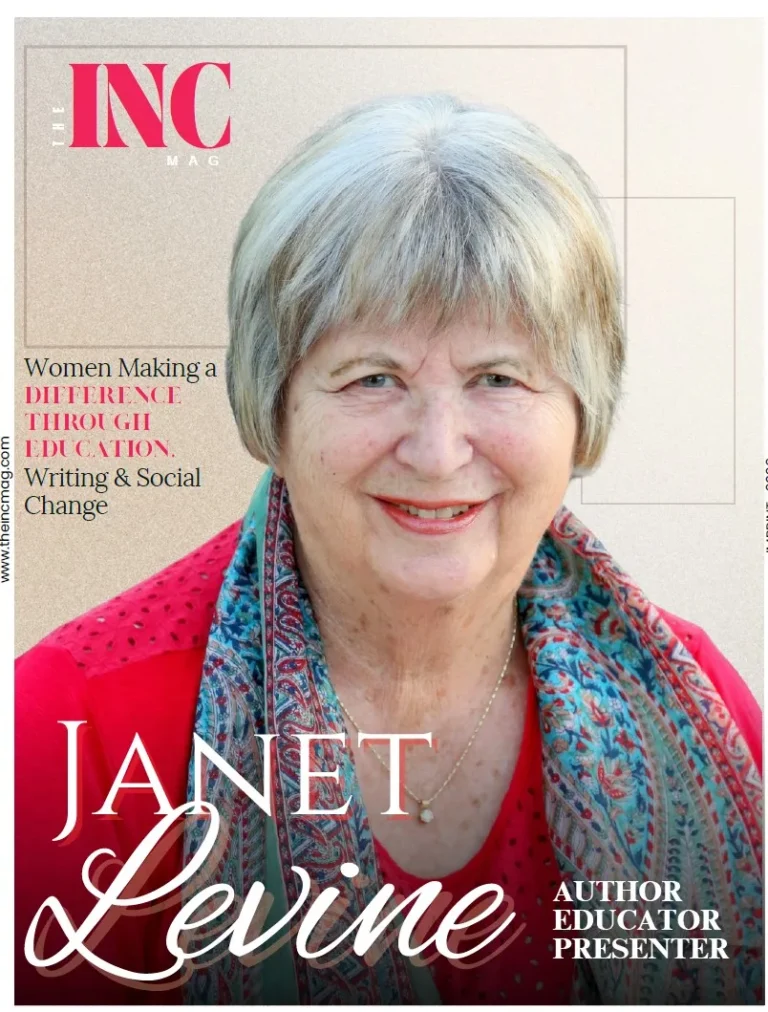
Janet Levine: A Life Shaped by Writing, Courage, Education, and Transformation
Cover Story
Levine’s connection with writing began early. At just 18, she was already contributing opinion pieces to the Rand Daily Mail, then the only liberal newspaper in South Africa. Her early writing was shaped by a growing commitment to political change, rooted in her involvement in anti-apartheid activities from the age of 13. At 29, she was elected to the Johannesburg City Council, becoming both its youngest member and its first woman. Her years in public life gave her a close view of social divisions, political tensions, and the inequalities that shaped South African society. These experiences later became part of her political memoir, Inside Apartheid.
Her voice reached an even wider audience when she became a weekly columnist for The Sowetan, one of South Africa’s largest Black-circulation newspapers. For three years, she was the first and only white writer to write for a Black audience at the publication. The opportunity allowed her to communicate with hundreds of thousands of disadvantaged Black South Africans and deepened her understanding of the importance of listening across social and cultural boundaries.
Building a Life Around Purpose and Learning
In 1984, Levine immigrated to the United States, beginning another significant chapter. She published Inside Apartheid and later co-founded the Independent Schools South Africa Education Program, or ISSAEP, on the East Coast. Over four years, the program helped bring more than 100 students to the United States, where they went on to attend prestigious universities on scholarships. One of the students, Mvelase, became the subject of an article Levine wrote that appeared in the New York Times Sunday Magazine.
Education became an increasingly important part of her professional identity. Her interest in the Enneagram personality model led her into an intensive study of the system and eventually to the founding of an Enneagram Teachers Association. She also wrote two books adapting the model for specific audiences, one for educators and another for parents. Through Transforming Teaching Workshops, she traveled internationally to introduce the Enneagram to educators at all levels, from elementary and secondary school teachers to tertiary-level educators.
Her educational career also included 30 years at Milton Academy, where she taught English literature and philosophy, primarily to senior students. The long teaching career gave her an opportunity to influence generations of young people while continuing to explore the relationship between ideas, character, learning, and personal development.
After retirement, Levine did not step away from intellectual work. Instead, she became a full-time writer. Her books have explored subjects ranging from the importance of reading to historical and personal storytelling. Reading Matters examines the significance of reading, while Liv’s Secrets is a historical family saga set in South Africa during the 20th century. Her forthcoming novel, The Awakening of Diya Sharma, moves between New York City and an ashram in northern India and explores meditation, Buddhism, and the Enneagram. She is also currently working on a memoir.
Leadership Through Listening and Integrity
For Levine, leadership is not defined simply by position or authority. It begins with paying attention to people. Her philosophy is rooted in listening carefully, regardless of a person’s age, background, or position.
“Listen carefully to what people are saying, whatever their age and whatever their station in life in whatever situation you find yourself,” she explains.
That principle is matched by a strong belief in honesty and personal responsibility. Levine believes leaders must be willing to speak their truth even when it may be difficult for others to hear. She also places importance on kindness, self-belief, perseverance, and accepting responsibility when others make mistakes.
Her approach reflects lessons gained through both professional and public life. Leadership, in her view, is not about avoiding difficult situations. It is about remaining steady when circumstances become challenging and continuing to act with integrity.
Facing Barriers With Persistence
Levine’s career has not been without resistance. As the only woman and one of the youngest members of the Johannesburg City Council, she encountered misogyny and often found that her contributions were not taken seriously. She had to fight to have her voice heard and to ensure that her ideas received serious consideration.
She also confronted racism during a period of profound social and political division in South Africa. Her experiences made her strongly opposed to racism and injustice, issues she continues to regard with deep conviction. Professional jealousy was another challenge she encountered throughout her career, particularly as her achievements became more visible.
Yet these experiences did not cause her to retreat. Instead, they strengthened the persistence that has remained one of the defining qualities of her journey.
The Power of Mentorship
Levine also recognizes that achievement is rarely the result of individual effort alone. Throughout her career, she benefited from mentors, particularly women who helped create opportunities and opened doors.
She has sought to extend that same support to others. “No one does this journey alone. We all need to have a support group around us at whatever stage we are in our careers,” she says.
This belief has shaped her view of professional growth and leadership. Mentorship, for Levine, is not simply about receiving guidance. It is also about creating opportunities for the next generation, particularly for women who may face barriers similar to those she encountered.
A Legacy Through Words and Ideas
Levine does not attempt to define her success through a single achievement. Her career spans journalism, politics, education, advocacy, teaching, personality studies, and literature. Each chapter has contributed to a larger body of work centered on people, ideas, and the power of knowledge.
She leaves judgments of success to others, but she has a clear hope for her legacy. Her books, she believes, can preserve her memories, thoughts, and reflections for future generations. She also hopes that former students will continue to remember the lessons and advice she shared with them during her teaching years.
Her advice to aspiring professionals is direct: ambition matters, but persistence matters even more. She encourages people to build self-belief and confidence while remaining true to themselves.
Looking ahead, Levine’s priorities are becoming more personal. After a remarkably active decade since her retirement, she hopes to spend more time with family, reading, exercising, traveling, and simply enjoying a greater sense of relaxation.
Yet even in retirement, writing remains part of her life. With a new novel and memoir in progress, her creative journey continues. For Janet Levine, a meaningful career has never been limited to one profession or one definition of success. It has been an ongoing process of learning, questioning, teaching, writing, and connecting with people.
Her story demonstrates that impact can take many forms. It can emerge through a newspaper column, a political decision, a classroom lesson, an educational opportunity, a book, or a conversation that changes how someone sees the world. Across decades and continents, Levine has continued to use her voice with purpose, proving that a life shaped by curiosity and courage can leave an enduring mark.