
Technology moves forward when people are willing to question what has already been accepted. While many innovators focus on improving existing systems, others look further and ask whether a completely different approach could solve the problems ahead. Dr. Ko-Cheng Fang, Founder of LongServing Technology Co., represents this second kind of innovator. His career has been shaped by independent thinking, cross-disciplinary learning, and a willingness to pursue challenges that others may consider too difficult.
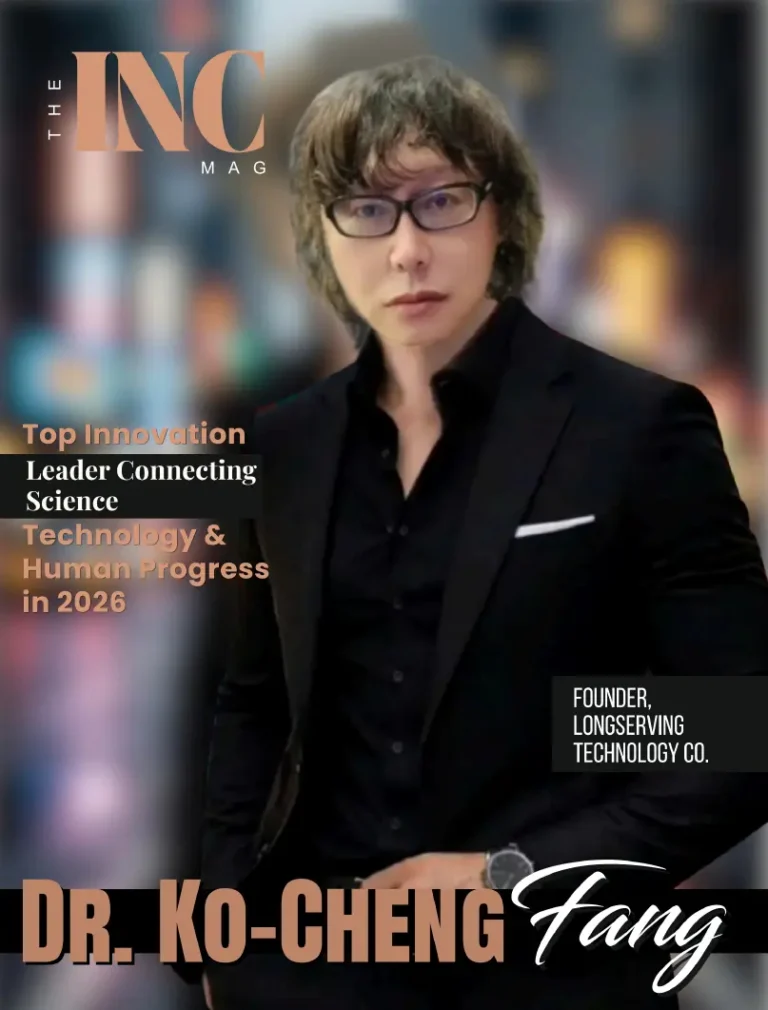
Dr. Ko-Cheng Fang: Challenging Limits and Building the Next Era of Photonic Computing
Cover Story
His professional journey has crossed several fields, from information security and cloud architecture to materials science and photonic computing. Rather than limiting his work to one area, Dr. Fang has continued to explore connections between different disciplines. This approach has allowed him to develop ideas that challenge conventional technology and explore new possibilities for the future.
One of the early defining moments in his career came before smartphones became widely adopted. He recognized the potential of cloud security and established an early foundation through pioneering cloud cybersecurity patents. His journey later moved into materials science, where he successfully addressed difficult technical challenges related to laboratory-grown emeralds, an area once considered extremely difficult to achieve.
Today, his attention is focused on another major technological challenge: the limits of conventional electronic computing. Through LongServing Technology Co., Dr. Fang is developing X-Photon materials, photonic memory, and an all-optical architecture designed to explore a new direction for computing and AI infrastructure.
Leadership Built on Independent Thinking
Dr. Fang’s leadership philosophy begins with a simple principle: established ideas should always be questioned.
He does not believe that following market trends is enough to create meaningful innovation. Instead, he encourages a deeper examination of whether existing approaches are capable of addressing future challenges. This requires the confidence to challenge conventional thinking and the patience to pursue an idea even when immediate results are not guaranteed.
Three values have remained central to his approach: independent thinking, resilience, and long-term responsibility.
Dr. Fang believes that setbacks are an unavoidable part of research and development. Delays, criticism, skepticism, and technical difficulties can test both individuals and organizations. Instead of viewing these experiences as failures, he sees them as opportunities to improve the work and strengthen the people behind it.
His philosophy is firmly focused on the long term. Rather than pursuing short-term gains, he seeks to address fundamental challenges that could affect technology and society over the coming decades. This mindset also creates a strong sense of responsibility toward his team and the wider community.
Innovation Beyond Traditional Boundaries
A defining feature of Dr. Fang’s career is his ability to learn independently across disciplines. His experience spans information security, cloud technology, materials science, and photonics, giving him a broad perspective on technological development.
This cross-disciplinary approach has become particularly important in his work on photonic computing. The challenges facing modern computing cannot always be solved by simply making existing electronic systems more powerful. As computing demand increases, particularly because of artificial intelligence, new approaches to speed, memory, and energy efficiency are becoming increasingly important.
Dr. Fang’s response has been to look beyond traditional electronic chip architecture.
His work with X-Photon materials and all-optical architecture reflects an effort to rethink how computing systems can be designed at a fundamental level. Rather than simply extending an existing model, the approach seeks to establish a different technological foundation for future computing.
For Dr. Fang, innovation is therefore not limited to developing another product. It is about finding solutions to problems that could become more significant over the next 10 to 20 years.
A Major Breakthrough in Photonic Technology
Among Dr. Fang’s proudest achievements is his work in photonic memory and photonic chip technology. His research is aimed at addressing the “memory wall” and other physical limitations associated with conventional electronic chips.
According to the information provided by Dr. Fang, the company’s proprietary X-Photon materials and all-optical architecture have achieved a thousand-fold increase in computing speed while reducing energy consumption by 90 percent.
The importance of this achievement extends beyond performance figures. The rapid growth of AI has created enormous demand for computing capacity, while the energy required to operate advanced computing infrastructure has become an increasingly important concern.
This places technologies that can potentially deliver greater computing performance with lower energy use at the center of an important global conversation.
Dr. Fang views the development of photonic memory and photonic chips as more than a collection of technological achievements. He sees it as an opportunity to open a new direction for AI infrastructure and help overcome some of the limitations facing conventional electronic architectures.
Turning Obstacles into Lessons
The path to technological innovation is rarely straightforward. For Dr. Fang, some of the most difficult obstacles have come not from the technology itself but from the process of bringing advanced technology into the commercial market.
Market understanding, supply chain support, intellectual property protection, equipment, and access to specialized talent have all presented challenges. His early cybersecurity patent work also required him to remain anonymous because of confidentiality restrictions.
These experiences shaped his understanding of what is required to turn innovation into sustainable business value.
A breakthrough idea needs strong intellectual property protection. It also needs manufacturing capabilities, capable people, reliable supply chains, and a clear strategy for commercialization. Without these foundations, even promising technologies can struggle to reach the market.
For Dr. Fang, resilience has therefore become a central part of leadership. He believes innovators must be prepared to work through periods of uncertainty and even isolation while remaining committed to their core purpose.
Influences That Shaped His Leadership
Dr. Fang’s leadership approach has been influenced by a wide range of ideas and figures. Among them, Nikola Tesla has had a particularly strong impact.
Tesla’s ability to imagine technologies beyond the boundaries of his time resonates with Dr. Fang’s own approach to innovation. Tesla’s story also demonstrates the challenges faced by pioneers who attempt to introduce ideas before the market or society is fully prepared for them.
Dr. Fang has also drawn lessons from Buddhist teachings, meditation, historical battles, and business strategy. Meditation has helped him maintain calm and perspective when facing difficult decisions and technological challenges.
His interest in business strategy has reinforced another important lesson: technological strength must be supported by business strength. A breakthrough must eventually produce tangible results if it is to achieve wider recognition and create lasting impact.
Building Toward Global Commercialization
The next phase of Dr. Fang’s journey is focused on bringing photonic chip and photonic memory technologies from research and development into global commercial deployment.
His plans include building strategic partnerships with leading semiconductor foundries and preparing LongServing Technology Co. for a future Wall Street listing.
This next stage will require the company to move beyond technological development and establish a strong position across the global supply chain. Partnerships, manufacturing capabilities, intellectual property, market adoption, and scalability will all play important roles.
For Dr. Fang, one of the most exciting possibilities is seeing the technology move from the laboratory into real-world infrastructure.
The broader ambition is to contribute to the development of AI computing and green data centers by creating an architecture capable of addressing both computing capacity and energy consumption challenges.
A Vision That Extends Beyond Technology
Dr. Fang’s definition of success goes beyond financial results or personal recognition. He measures achievement by whether breakthrough ideas can be transformed into practical solutions for major challenges.
His long-term vision is to create an innovation platform that can contribute to the next generation of AI infrastructure while encouraging future innovators to think independently.
He believes aspiring entrepreneurs should look beyond short-term market trends, learn across disciplines, and develop the courage to question established assumptions. Most importantly, they should develop the resilience required to continue when progress is slow.
This philosophy reflects the journey that has shaped his own career. From cybersecurity and materials science to photonic computing, Dr. Fang has repeatedly chosen difficult paths in pursuit of new possibilities.
Shaping the Future of Computing
The future of technology will depend not only on faster systems, but also on finding more efficient and sustainable ways to support growing computing demand. Artificial intelligence is accelerating this need, creating pressure for new approaches to computing architecture.
Dr. Ko-Cheng Fang is positioning LongServing Technology Co. within this emerging landscape by pursuing photonic technologies that challenge the traditional boundaries of electronic computing.
His journey demonstrates that innovation often begins with a question: what if the accepted way is not the only way?
By combining independent thinking, technical exploration, resilience, and a long-term vision, Dr. Fang continues to pursue that question. His goal is not simply to advance a technology, but to help create a new foundation for the computing systems of tomorrow.
As LongServing Technology Co. moves toward global commercialization, his work represents a continuing effort to turn ideas that once seemed impossible into tangible possibilities for the future of AI, computing, and sustainable technology.