
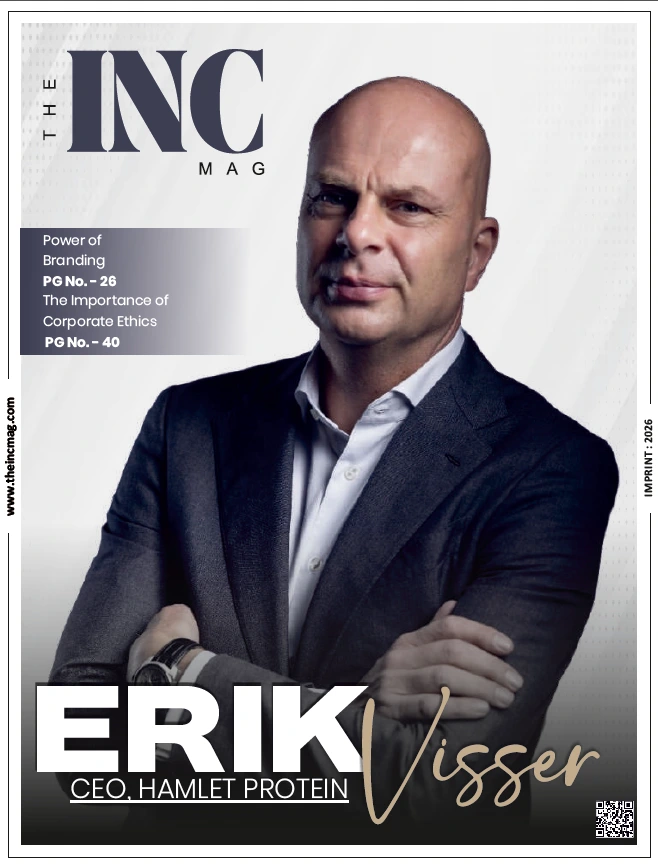
This edition proudly recognizes Erik Visser as a dynamic industry leader celebrated for his exceptional contributions to innovation and sustainable growth in animal nutrition. As the Chief Executive Officer at HAMLET PROTEIN, he embodies excellence in building trusted global partnerships, delivering science-driven nutritional solutions, and driving long-term value creation. In this insightful feature, explore his inspiring journey of strengthening international collaborations, empowering producers through advanced protein technologies, and creating lasting impact within the global agrinutrition landscape.
Change Makers: The Most Empowering Leaders to Watch in 2026
Cover Story
Erik Visser: Driving Sustainable Growth in Global Animal Nutrition
When Erik Visser reflects on his career, it is clear that his leadership story was shaped as much by geography as by ambition. From his early decision to leave his home country and experience the world, to leading a global nutrition company focused on the earliest stages of animal life, Visser’s journey is defined by curiosity, adaptability, and a deep belief in the power of people. Today, as CEO of Hamlet Protein, he leads with a global mindset, a hands-on approach, and a clear sense of purpose: to strengthen animal health and performance by getting nutrition right from the very beginning.
Visser’s professional path did not follow a conventional route. While many of his peers entered structured graduate programs at large multinational companies, he chose a different start. Soon after graduating from university, he left Europe to work in chemical distribution in Guatemala. With limited experience, basic language skills, and little certainty about what lay ahead, he stepped into an environment that demanded resilience and fast learning. What began as a leap into the unknown became the foundation of a twelve-year career across Central and South America, and later Europe and Scandinavia.
Those early years shaped Visser’s leadership philosophy in lasting ways. Living and working across cultures taught him that success depends on listening first, adapting quickly, and respecting local ways of thinking. It also taught him that strong relationships, built on trust and understanding, are the backbone of sustainable business. These lessons continue to guide his leadership at Hamlet Protein, a company whose global reach and scientific focus place it at the heart of modern animal nutrition.
A Journey Shaped by Culture and Challenge
Visser’s professional journey began with a desire to explore rather than escape. He did not leave his home country because he was dissatisfied, but because he wanted to learn from other cultures and broaden his perspective. His first role in Guatemala placed him far outside his comfort zone. He was young, inexperienced, and operating in a complex market that demanded independence and problem-solving skills from day one.
Over the next twelve years, Visser worked across Central and South America, navigating economic volatility, cultural diversity, and business challenges that no textbook could fully prepare him for. These experiences forced him to grow quickly, both personally and professionally. He learned new languages, managed teams across borders, and made decisions under pressure, often with limited information.
What stood out during this period was the importance of cultural sensitivity. Visser learned that success in a new environment does not come from imposing familiar models, but from blending approaches. By combining local knowledge with external experience, he developed a leadership style that values flexibility and collaboration. “Working and living in different cultures only works if you embrace your new environment and are eager to learn,” he has said. That mindset became a defining element of his leadership identity.
After more than a decade abroad, Visser returned to Europe. Surprisingly, the transition back proved as challenging as his original move overseas. Re-adapting to a familiar environment required adjustment, as both he and the professional landscape had changed. Rather than seeing this as a setback, Visser treated it as another opportunity to grow. He consciously blended the relationship-driven approach he learned in Latin America with the structured, data-driven business culture of Europe. This combination became a distinctive strength, particularly in international leadership roles.
Leadership Grounded in People and Purpose
As CEO of Hamlet Protein, Visser’s leadership philosophy is guided by a simple but powerful belief: people come before processes. He is convinced that sustainable performance starts with building the right team and creating an environment where individuals can perform at their best. Strategies and systems matter, but only when they are supported by trust, clarity, and shared purpose.
Visser places strong emphasis on selecting and developing talent. He believes leaders must invest time in shaping a culture that people are proud to be part of. Clear expectations, accountability, and open communication form the foundation of this culture. In complex or high-pressure situations, these elements become even more critical, as they allow teams to stay aligned and focused.
His leadership style can best be described as that of a player-coach. Rather than leading from a distance, Visser stays close to the business. He spends time in the market, visits customers, and engages directly with teams across the organization. This hands-on approach helps him understand real challenges, make informed decisions, and remove obstacles quickly. It also sets a clear example of the behavior he expects from others.
Energy and authenticity are central to Visser’s approach. He sets high standards for himself and his teams, while maintaining perspective and a sense of humor, especially in difficult moments. He believes this balance helps teams stay motivated and confident, even when navigating uncertainty or change. For Visser, leadership is not about control, but about creating the conditions for others to succeed.
Turning Challenges Into Lasting Strength
Throughout his career, Visser has faced numerous challenges, each contributing to his growth as a leader. Two experiences stand out as particularly formative. The first was cultural adaptation and re-adaptation. Moving to Latin America required learning new ways of working and living, but returning to Europe demanded an equally deliberate adjustment. By consciously blending the strengths of both environments, Visser developed a leadership style that is both empathetic and structured.
The second defining challenge was leading organizations through turnaround situations. Managing a business in distress requires a different mindset than optimizing a healthy operation. In these environments, Visser learned the importance of clarity and decisiveness. Establishing a credible roadmap, making tough decisions, and building a strong core leadership team became essential priorities.
Operating under pressure accelerated learning and strengthened alignment. Visser discovered that transparency and trust are especially important during difficult times. When teams understand the challenges and believe in the plan, they are more likely to commit fully. These experiences reinforced his belief that adversity, when approached with honesty and focus, can become a catalyst for long-term growth.
Transformational Leadership in Practice
Visser believes transformational leaders are defined by their ability to combine clarity of purpose with the courage to change. Rather than simply managing performance, they reshape ambition, culture, and direction. In his view, three qualities distinguish such leaders.
The first is strategic clarity paired with decisiveness. Transformational leaders see the organization as a whole, make choices grounded in facts and long-term value, and act with confidence, even under uncertainty. This is particularly important in fast-moving or high-stakes environments.
The second quality is emotional and cultural intelligence. Having worked across continents, Visser has seen that sustainable change only happens when leaders can engage people at all levels. Building trust, adapting communication styles, and aligning diverse stakeholders behind a shared narrative are critical skills.
The third quality is the ability to set high standards while empowering others. Transformational leaders create accountability but also invest in developing talent and encouraging ownership. They lead by example, especially in difficult moments, and are willing to challenge established assumptions, including their own. For Visser, true transformation leaves organizations stronger, more agile, and better prepared for the future.
Hamlet Protein: Nutrition at the Start of Life
Hamlet Protein was founded in 1989 with a clear belief: the right nutrition in the earliest stages of life determines the health and performance of animals throughout their lifetime. This focus on young animal nutrition remains at the core of the company’s mission today.
Specializing in soy-based ingredients, Hamlet Protein has built its reputation on consistent product performance supported by extensive scientific research. Close relationships with customers and partners have made the company a trusted supplier across global markets. Its solutions are designed to support animal health, welfare, and productivity, particularly in swine, poultry, and ruminant production.
The company operates production facilities in Denmark and the United States, with a sales office in China and experts located in key markets worldwide. By combining local expertise with global knowledge, Hamlet Protein delivers practical solutions tailored to regional needs. Visser sees this proximity to customers as a key differentiator and a source of long-term value.
Fostering Growth and Resilience
Under Visser’s leadership, success at Hamlet Protein is closely linked to culture. He believes growth happens in environments where people feel empowered, trusted, and accountable. Accessibility plays an important role in this approach. Visser maintains an open-door mindset and spends time on the production floor and in the field, not as a formality, but to understand what truly matters to teams.
Psychological safety is another cornerstone. Visser encourages people to speak up, challenge assumptions, and share ideas without fear. He views well-intended failure as part of progress, provided lessons are captured and applied. This perspective allows teams to experiment, learn, and improve continuously.
Collaboration is reinforced through shared goals rather than isolated targets. By aligning teams around common objectives, Visser promotes collective ownership and breaks down silos. Recognition also plays a key role. Celebrating achievements, especially during challenging periods, builds pride and resilience. Together, these elements create an environment where innovation and engagement can flourish.
Learning, Mentorship, and Networks
Mentorship and continuous learning have been central to Visser’s own development, and he actively promotes both within the organization. Early in a career, mentors help individuals understand how things work and build confidence. At more senior levels, mentorship becomes a valuable source of perspective when navigating complex decisions.
Visser has benefited from both internal mentors and external coaches. Internal guidance helped him understand organizational culture, while external perspectives provided objective input as his responsibilities grew. He encourages leaders at all levels to seek similar support and to remain open to feedback.
Learning, in Visser’s view, never stops. While formal training has its place, much of the most meaningful development comes from experience and reflection. Networking also plays an important role by exposing leaders to different industries and viewpoints. These connections challenge assumptions and prevent narrow thinking, strengthening both individuals and the organization.
Staying Close to the Market
For Visser, alignment with customer expectations and market trends begins with proximity. He believes it is impossible to understand customer needs from behind a desk. As a result, he and his team spend significant time working directly with customers, visiting farms and feed mills to gain firsthand insight into operational challenges.
Distributors provide valuable local intelligence, helping the company respond effectively to regional differences. Engagement with industry experts, academic institutions, and broader networks allows Hamlet Protein to anticipate technological and regulatory developments. Close relationships with suppliers further enhance visibility across the value chain.
This continuous exposure to the market enables the company to sense change early and adapt quickly. For Visser, staying relevant means remaining practical, responsive, and forward-looking.
Opportunities and Challenges in a Changing Industry
Visser sees strong long-term fundamentals in the animal nutrition industry. Global demand for animal protein continues to grow, driven by population growth and rising incomes. An optimal use of available resources requires efficient and responsible production.
Regulatory shifts, particularly the reduction of antibiotic use, are reshaping production systems. This places greater emphasis on nutrition, health management, and prevention. Early-life nutrition, a core focus for Hamlet Protein, is gaining recognition as a critical factor in unlocking lifetime performance.
Sustainability presents both a challenge and an opportunity. Producing more food with fewer resources and with a reduced environmental impact requires innovation in feed efficiency. Visser believes nutritional solutions can play a meaningful role in building more sustainable food systems.
At the same time, geopolitical uncertainty introduces volatility across supply chains and markets. Navigating this complexity requires adaptability, resilience, and decisive leadership. Visser believes companies that combine technical excellence with agility and market insight will be best positioned for success.
A Forward-Looking Vision
Looking ahead, Visser’s long-term goals are centered on growth and continuity. His ambition is to build organizations that are stronger and more competitive than when he joined them. This means investing in capabilities, developing people, and ensuring the business can adapt long after any individual leader moves on.
On a personal level, Visser remains committed to continuous development. He views leadership as an ongoing journey and seeks opportunities to learn and challenge himself. Supporting the growth of others is a key priority, as he believes enabling people to succeed is one of the most meaningful contributions a leader can make.
Rather than focusing on personal legacy, Visser concentrates on consistent, values-driven action. By strengthening teams, supporting stakeholders, and building resilient organizations, he believes a positive legacy will follow naturally. In leading Hamlet Protein, Erik Visser continues to demonstrate that strong foundations, built on people, purpose, and perspective, are essential to lasting impact.